
Getting Carroll County Court Records
Need a county criminal or civil copy? The Carroll County Public Record Request form is the simplest path. It asks whether you want inspection or copying. It also wants the record type, date range, subject, and keywords. Begin with the court named on your pleading, citation, notice, or docket. In Carroll County, the split matters. Sarah Bradberry's Circuit Court Clerk office keeps Circuit Court civil and criminal records. General Sessions runs separate criminal and civil clerks. Kenneth Todd, the Clerk and Master, holds Chancery files and ordinary probate or estate records. City cases belong to municipal court clerks, and Juvenile Court maintains juvenile files.
- Identify the court office and case type.
- Search Carroll TnCIS when Circuit Court or General Sessions is involved.
- Choose inspection, a plain copy, or a certified copy.
- Describe the case and document with a number, date range, and keywords.
- Submit through a clerk-approved channel, pay the quote, and preserve the response.
Each contact method has its place: the counter, mail, telephone, and email. County materials give (731) 986-1932 for the Circuit Court Clerk. TnCIS shows (731) 986-1931. Civil staff with record-payment material use (731) 986-1929. Call ahead to confirm which line is current.
Carroll Court Record Custodians
Searching the wrong office is the most common reason a record seems missing. Court clerks maintain records and manage dockets, as the Tennessee clerk locator explains. In Carroll County, that work is divided among several offices.
| Record family | First custodian | Route |
|---|---|---|
| Circuit civil or criminal | Circuit Court Clerk | TnCIS, then clerk file |
| General Sessions | Criminal or civil clerk | TnCIS, then division clerk |
| Chancery or probate | Clerk and Master | Direct request |
| Municipal citation | City Court Clerk | City channel |
| Juvenile | Juvenile Court | Restricted inquiry |
A city-held case does not become a Circuit Court file just because the event happened inside the county. The custodian follows the court, not the map.
Court Record Types
A court record is more than a docket sheet. The docket is the running chronological index of filings, settings, and outcomes, while the full file may hold the documents behind each entry. Access can differ by item, case type, order, and custodian.
- Docket sheets and case-event histories
- Complaints, petitions, motions, and answers
- Orders, judgments, and dispositions
- Criminal charge and hearing records
- Civil, Chancery, probate, and estate papers
- Municipal traffic and ordinance records
TnCIS works as an index and case-information channel for participating offices, not a promise of every scanned filing. When the actual paper matters, ask the clerk for it by name.
Describe Carroll Records Precisely
The county form asks for type, timeframe or dates, and subject or keywords. Add the case number when you have one. Carroll TnCIS offers 99GS1-2023-CR-12345 as a format example. Its Case Number box accepts only the trailing 12345. Keep both values in your request trail.
A strong request names the court first. Then it gives the criminal or civil category, the reference, the date span, and the document you need. It also states whether you want inspection, a non-certified copy, or certification. Get a fee estimate before any large copy job. The form prints no tracking number, response deadline, dedicated submission email, or appeal field. Keep your own copy and ask how the clerk will identify the response.
Best detail: Ask for the docket sheet and a named motion, order, judgment, or disposition instead of “all records” with no court or dates.
Inside a Carroll County Court Record
The county's General Sessions criminal docket shows a scheduled list. That list differs from a full file. Each row carries a case number, officer, case style, party role, and attorney field. It adds the count, charge, violation date, hearing type, and hearing time. Nothing there is a verdict. A charge label stays an allegation until you check the outcome.
| Case identity | Number, court, year, reference, and style |
|---|---|
| Parties | Roles and counsel where public |
| Filings | Petitions, answers, motions, notices, and papers |
| Settings | Date, time, hearing type, judge, and resets |
| Outcome | Disposition, order, judgment, sentence, or relief |
| Copy status | Inspection, office copy, scan, or certification |
An online case shell can leave out a document image or a protected field. When the portal and a signed order disagree, the clerk's file settles it.
Carroll Court Record Portal Warning
The TnCIS terms state that public data is not official clerk information and can change. Skip the Subscription Login on the landing page. It is not needed for public searching. Results cap at 2,500 rows. A broad docket search may need tighter court, case-type, year, or reference terms.
The office filters cover only Circuit Court and General Sessions. That leaves no public countywide probate search, juvenile search, or shared municipal docket. Tennessee Public Case History tracks appeals, not every Carroll trial case.
View the official Carroll portal warning.
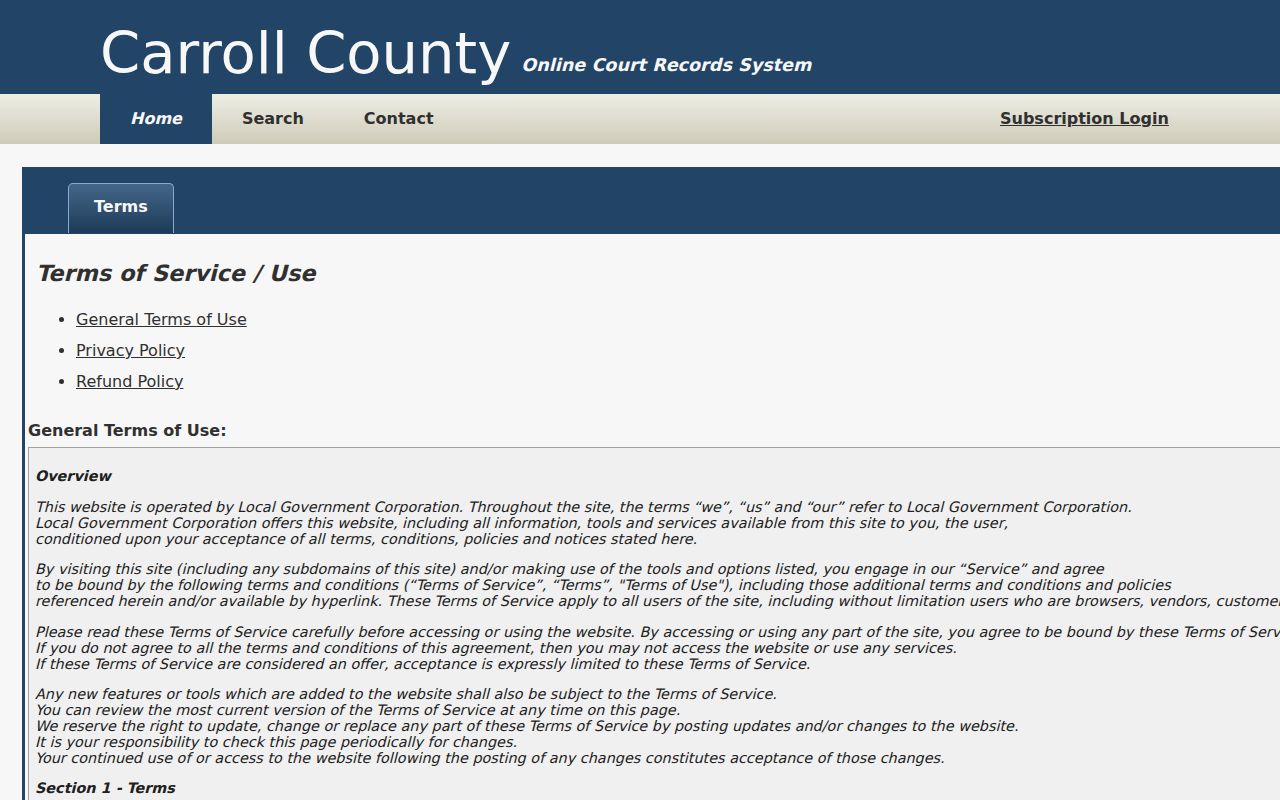
The notice is a lesson in itself. A convenient match should lead you back to the originating clerk whenever certification or legal accuracy matters.
Fees and Certified Copies
A plain copy just reproduces the record. A certified copy adds the clerk's certification and seal, and the form says charges are paid in full. Mail payment may use a cashier's check or money order. Include a self-addressed stamped envelope for the response.
| Item | County-published amount |
|---|---|
| Non-certified copy | $0.50 per page |
| Certified copy | $5 per certification and seal, plus $0.50 per page |
| Public TnCIS search | No price shown |
| Another custodian's record | Confirm that office's fee |
Criminal Court Clerk's Office
99 Court Square, Suite 103
Huntingdon, TN 38344
(731) 986-1929 payment line
Do not carry the county form's rates over to a municipal, Chancery, juvenile, or federal file. Those custodians must confirm their own charges.
Carroll Court Record Clerk Roles
Tennessee judiciary materials describe the recordkeeping role behind any Carroll County court record search. Clerks maintain records, manage docket activity, receive filings, and provide lawful access.
See official clerk-finding guidance.
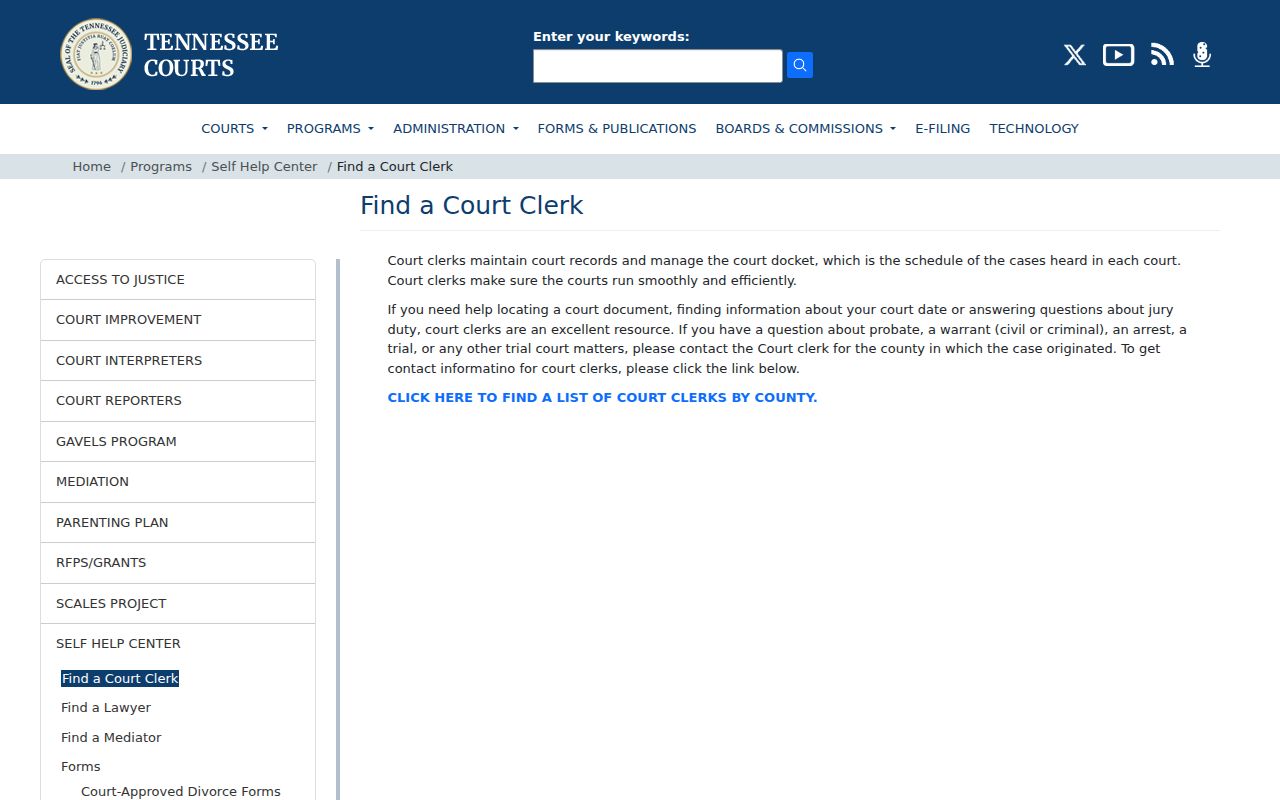
The locator works best once you know the court level, because Carroll County uses several custodians.
Read the judiciary's clerk overview.
Those duties explain why the clerk, not an outside search result, issues a certified record.
Sealed Records and Public Access
Tennessee Supreme Court Rule 34 presumes public inspection, limited by statutes, sealing orders, protected material, and court-function needs. The Tennessee Public Records Act sets the wider baseline. Neither opens a file guarded by a specific law or order.
Key rules:
T.C.A. §§ 10-7-503 and 10-7-504 address inspection and confidential records.
T.C.A. § 37-1-153 gives juvenile files separate treatment.
T.C.A. § 40-32-101 and AOC guidance explain court-ordered expunction.
Expunction never happens automatically. It starts in the court where the matter began. A sealed, expunged, juvenile, adoption, protected-family, or redacted record may simply not appear online, and a blank result never tells you why.
Sealed records: On top of that baseline, the clerk follows whatever statute or court order governs the specific file you ask for.
Carroll Court Record Statistics Context
Tennessee's AOC annual report breaks out caseload figures for the 24th Judicial District's Chancery, Circuit, and Criminal courts. Treat those numbers as context for how the courts run, not as a record of any live case. Open the official FY2024 report.
Statistical reports are for sizing up the system. For what actually happened in a single Carroll County case, rely on the docket and the clerk's file.
Note: Log the URL, retrieval date, custodian, and copy status so later portal or PDF changes remain clear.
Carroll Court Record Delivery Choices
The Carroll County request form lists pickup, email, fax, and mail as delivery options. Checking a box signals a preference, nothing more. The form itself publishes no dedicated submission email or fax number. Ask the clerk where to send your request. Ask whether that format actually works. Mail goes through the criminal clerk process. Enclose the return address and the self-addressed stamped envelope the form calls for.
Keep a short paper trail. Save the signed request, the date it arrived, and any fee estimate. Add the promised delivery date. A delay may be simple retrieval time. Or it may be a fee problem, a denial, or a request sent to the wrong Carroll court.
If access runs into a wall, ask the clerk to name the reason. The answer may be sealing, confidentiality, expunction, redaction, retrieval time, or the wrong office holding the file. Write down the rule, order, or explanation you are given.